

 Book Service!
The Thermostat Myth
You pull into the driveway after a long, blazing July afternoon hiking the high trails at Mineral Ridge, floating the Spokane River, or walking the wooden boardwalk in Coeur d’Alene. You open your front door, and a wall of stagnant, trapped heat hits you in the face.
In a desperate bid for immediate relief, you march straight to the thermostat and turn the temperature setting down to 60°F or 62°F. Your brain tells you it’s common sense: if I give it a lower target, it will blast colder air, work harder, and cool the room down faster.
Unfortunately, that is not how residential HVAC systems work.
As your local Inland Northwest HVAC contractor team at Prairie Heating & Air, we troubleshoot frustrated homeowners across Kootenai and Spokane County every summer who wonder why their system takes hours to recover from the afternoon heat.
Today, we are pulling back the curtain on the actual physics of Inland Northwest cooling, busting the thermostat myth, and showing you how to outsmart our region’s unique climate to get fast relief.
1. The On/Off Switch vs. Thermostat Behavior
Your air conditioner has exactly one speed when it comes to cooling output: 100% capacity.
Whether you set your thermostat to a reasonable 72°F or an icy 55°F, the system does not change its operational behavior. It utilizes the exact same volume of electricity to turn on the outdoor compressor and the indoor blower fan.
The air exiting your supply vents is always the same temperature, typically about 15°F to 20°F cooler than the air entering your return air duct.
How Your AC Thinks
- Thermostat at 72°F ──► AC runs at 100% speed ──► Shuts off at 72°F
- Thermostat at 60°F ──► AC runs at 100% speed ──► Keeps running past 72°F (Wastes Energy)
Setting the thermostat to 60°F doesn’t act like a gas pedal; it acts like a stopwatch. You haven’t made the system work faster; you’ve just ordered it to run longer, ensuring it will overshoot your actual comfort zone, spike your Kootenai Electric or Avista bill, and potentially freeze up your indoor evaporator coil into a block of ice.
2. The Real Enemy: The Thermal Mass of North Idaho Homes
If the air coming out of your vents is immediately cold, why does it take so long for your house to actually feel comfortable?
Because you aren’t just cooling down the invisible air inside your rooms. You are fighting your home’s structural thermal mass.
Our Inland Northwest climate features intense, direct solar radiation during our long summer days. Your home’s sheetrock, framing studs, hardwood floors, and heavy furniture act like dense thermal batteries. They absorb heat all day long.
When your air conditioner turns on, it quickly chills the air molecules. But the moment that cool air circulates across your hot sofa, warm kitchen countertops, and heat-soaked drywall, those solid objects immediately dump their stored energy back into the air.
The Mechanical Reality: Your AC has to run long enough to pull the heat out of your belongings, not just the air. Dropping the thermostat lower does absolutely nothing to speed up the molecular rate at which sheetrock sheds heat.
3. The 70°F vs. 72°F Dilemma: A Massive Financial Difference
Many homeowners assume that keeping the house at 70°F instead of 72°F is just a minor adjustment. However, in our high-desert climate, those two degrees represent a significant chunk of your utility bill.
According to data from the U.S. Department of Energy, adjusting your thermostat just a few degrees higher can slash your summer cooling costs by up to 3% to 5% per degree. Here is why that shift matters so much in our region:
-
The Late-Afternoon Infiltration Peak: In North Idaho, our highest outdoor temperatures occur late in the day, often between 4:00 PM and 6:30 PM. Heat naturally transfers toward cold environments. The wider the gap between the blazing afternoon air outside and your indoor air, the faster outdoor heat forces its way through your windows and attic insulation. Keeping the target at 72°F minimizes this pressure, slowing down heat entry.
-
The Sensible Heat Grind: Because our summer air is relatively dry, your AC doesn’t have to spend massive amounts of energy pulling moisture out of the air (latent heat). Instead, it focuses entirely on dropping the actual temperature (sensible heat). Dropping a home from 72°F down to 70°F during peak outdoor heat forces the system into its most inefficient cycle of the day, running continuously when the outdoor condenser is already under maximum stress.
4. The Daily Strategy: Cruise All Day or Turn It Off?
Is it cheaper to leave your AC off while you’re out enjoying the Idaho sunshine and blast it when you return, or let it run all day?
The verdict: Turning it completely off is a major financial and mechanical mistake.
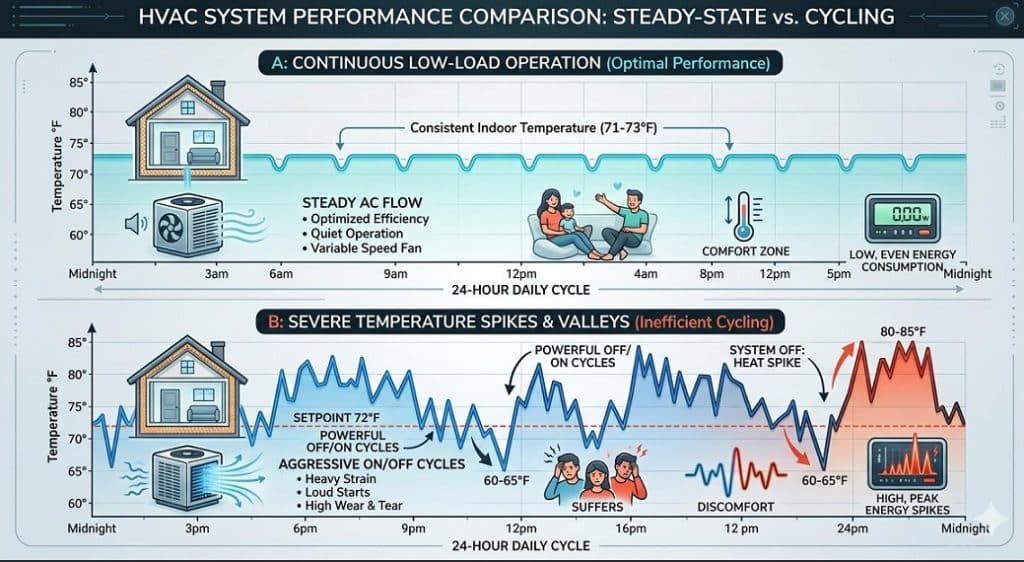
If you shut your system completely off on a 92°F afternoon in Post Falls, your indoor air will easily climb to 85°F, completely saturating your walls and furniture with thermal energy. When you flip it back on at 5:00 PM, your compressor has to perform a brutal deep recovery run, pounding away at maximum capacity for hours.
Furthermore, HVAC systems draw a massive surge of electricity, known as Locked Rotor Amps (LRA), every single time they start up from a dead stop to break the motor’s physical inertia.
The Prairie Heating & Air Smart-Drift Routine
Instead of turning the system off, utilize a smart or programmable thermostat to create a drift window:
| Time of Day | Ideal Thermostat Setting | System Status |
| Away at Work / Out on Lake | 78°F | Prevents home from becoming a total oven; keeps thermal mass stable. |
| At Home / Evening | 72°F – 74°F | Quick, highly efficient 4-to-6 degree recovery. |
| Late Night (Sleeping) | SYSTEM OFF/WINDOWS OPEN | Leverage our natural, crisp night air to cool the structure for free. |
5. How to Cool Your House Faster without Touching the Thermostat
If you want immediate relief when you walk through the door, skip the thermostat override and execute these three professional steps instead:
-
Step 1: Shift Your HVAC Fan to “ON”: Switch your thermostat’s fan setting from “AUTO” to “ON.” This keeps your furnace or air handler’s indoor blower motor running continuously. It forces air circulation across the rooms to break up stagnant hot air pockets, even when the outdoor compressor takes a break.
-
Step 2: Create a Wind-Chill Effect: Turn on your ceiling fans, ensuring they are spinning counter-clockwise. This pushes air straight down, creating an evaporative wind-chill effect on your skin that makes the room instantly feel up to 4 degrees cooler than the static air temperature.
-
Step 3: Block the Solar Engine: Close your blinds, cellular shades, or curtains on the south and west-facing windows before you leave the house. Direct sunlight piercing through glass introduces intense radiant energy. Blocking it stops the heat before it ever enters your home’s structural thermal mass loop.
Advice from the Owner of Prairie Heating & Air: Taylor Holt
I would argue that the most economical way to use your thermostat is to set it at the temperature you find comfortable and leave it there. If 72 degrees is where you’re most comfortable, keeping your thermostat consistently set at 72 often eliminates unnecessary adjustments and helps maintain a stable indoor environment.
One of the most common misconceptions homeowners have is believing that turning the thermostat way down will cool the house faster. It won’t.
Your air conditioner runs at the same cooling capacity regardless of whether you set the thermostat to 72 or 62. The only difference is that the system will run longer before shutting off, which can waste energy and make your home uncomfortably cold.
Consistency is often the simplest and most effective approach to comfort.
Is Your Air Conditioner Actually Falling Behind?
Sometimes, a slow-cooling home isn’t the result of a thermostat myth, it’s a cry for mechanical help. If your system is running non-stop and cannot seem to drop the temperature even late into the evening, use this quick checklist:
-
Weak airflow from your registers? Check your indoor air filter. A dust-caked filter chokes off airflow, crippling the heat exchange process.
-
Air blowing lukewarm instead of crisp? Your system might have a failed capacitor or a critical refrigerant leak.
-
System running constantly on hot days? Look at your outdoor condenser unit. If cottonwood fuzz from our local trees or dirt from summer winds has blanketed the coils, your AC cannot dump the heat it pulled from your house.
Don’t let a struggling system burn through your wallet this summer. If your air conditioner is running around the clock and failing to keep your family comfortable, let the local experts handle it.
Call Prairie Heating & Air at 208-619-6480 today or visit us online to schedule an absolute precision diagnostic.
Our licensed HVAC technicians will clear out the hidden efficiency killers and keep your Inland Northwest home genuinely comfortable all season long!