
 Book Service!
A Homeowners Guide to Why Your Inland Northwest AC is Freezing Up
Came home after work. It was 80° in the house. The AC was running. It looks like it froze. There’s a chunk of ice on the outside. Has this ever happened to you?
How does an air conditioner freeze solid when it’s blistering hot outside?
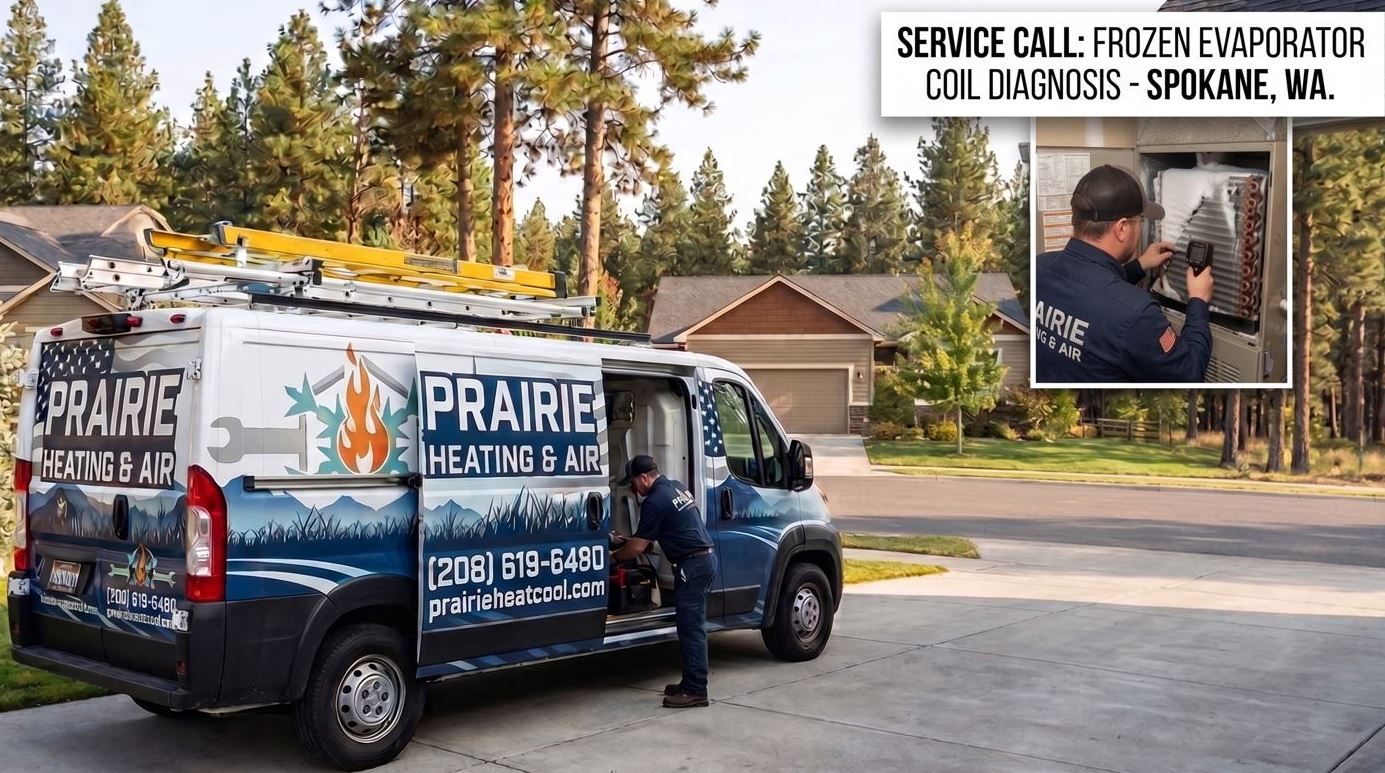
At Prairie Heating & Air, we see this exact issue every single summer from Spokane’s South Hill over to Coeur d’Alene. While ice looks like a cooling system working overtime, it’s actually a sign that your AC system is suffocating or starving.
You expect your air conditioner to blow refreshing, crisp air into your living room in the Inland Northwest. But when you get warm air blowing and your house is getting warmer, you need help fast!
Let’s dive into why this happens, how to understand it without an HVAC engineering degree, and what you need to do right now to protect your system.
The Cold Beer Trick: Understanding Your HVAC System
To understand why an AC freezes, you have to realize that your air conditioner doesn’t actually create cold; it removes heat from your home.
Inside your indoor unit sits the evaporator coil. Think of this coil like a freezing-cold can of soda sitting out on a humid Spokane deck in July. What happens to the outside of that can? Moisture from the air condenses onto it.
Under normal conditions, your home’s warm indoor air is continuously blown across this freezing coil. The air transfers its heat to the refrigerant inside, warming the coil slightly so it doesn’t freeze, while the moisture safely drips down into a drain line.
But if that balance is disrupted, if the coil gets too cold or the air stops moving, that condensation instantly turns to frost. Layer by layer, it builds up until your unit is entombed in a block of ice.
There are two main culprits behind this:
- Suffocation (Lack of Airflow)
- Starvation (Low Refrigerant)
Reason 1: Air Suffocation and Airflow Blockages
If your indoor coil doesn’t get enough warm air blown across it, the refrigerant inside stays below freezing, and the condensation turns to ice. This is the most common issue we find in local homes, and it’s usually caused by things you can fix yourself:
-
The Dreaded Dust Blockage: When was the last time you changed your furnace filter? In our region, between seasonal wildfire smoke, spring pollen, and everyday dust, filters clog fast. A heavily clogged filter acts like a wall, stopping warm air from reaching the coil.
-
Closed or Blocked Registers: If you’ve closed off vents in upstairs bedrooms or basement rooms to try and save energy, you might be suffocating your system. Your AC needs to breathe through all its vents to maintain proper pressure.
-
The High-MERV Trap: Homeowners trying to clean their air often buy the thickest, highest-rated allergy filters available at the big-box store. However, if your ductwork wasn’t engineered for that thick of a filter, it can restrict airflow so severely that it causes the system to freeze up.
Reason 2: Refrigerant Starvation and Leaks
If your airflow is perfectly fine, the system is likely starving for refrigerant.
A common myth is that an AC uses up refrigerant over time. It doesn’t. Your cooling system is a closed loop. If it’s low on refrigerant, you have a leak.
When a system is low on refrigerant, a drop in pressure occurs inside the evaporator coil. In HVAC physics, lower pressure means lower temperatures. The remaining refrigerant boils off much colder than it’s supposed to, instantly freezing the moisture in the air.
The Inland Northwest Wildcard: Low-Ambient Freezing
Our region has a unique climate quirk. In June and early September, we frequently experience extreme temperature swings—blistering daytime heat followed by crisp, chilly nights that drop into the 40s or 50s.
If you leave your AC set to Cool on a night when the outdoor temperature drops below 60°F, the system can easily freeze up. The outdoor air is already too cold to properly regulate the system’s pressure, causing the indoor coil temperature to plummet. If you need overnight cooling during these swing seasons, a heat pump or utilizing whole-home ventilation is a much safer bet.
What to Do RIGHT NOW – Don’t Skip This!
If you look at your HVAC system and see ice, turn the thermostat from “Cool” to “OFF” immediately, and turn your fan setting to “ON.”
Here is a piece of direct insider advice most corporate HVAC sites won’t tell you:
- Do not leave the AC running hoping it will fix itself, and do not call a technician out while it is still frozen solid.
- Why? An HVAC technician cannot diagnose a system that is encased in a block of ice. If we arrive and it’s frozen, we will have to turn it off and wait for it to melt before we can connect our gauges or check your airflow.
Turning the system to “OFF” and the fan to “ON” forces the indoor fan to blow warm household air over the ice, melting it safely before your technician arrives.
-
The Financial Risk: Forcing a frozen AC to keep running can cause liquid refrigerant to flood back into your outdoor compressor. Your compressor is designed to pump gas, not liquid. If liquid gets in there, it can destroy the compressor entirely. Turning a simple repair into a multi-thousand-dollar replacement.
How Prairie Heating & Air Can Help
Once your system has fully thawed, which can take anywhere from 2 to 12 hours depending on how thick the ice is, check your air filter. If it’s filthy, replace it and see if the system runs smoothly.
If the filter is clean and the system freezes right back up, you likely have a refrigerant leak or an underlying airflow restriction deep in your ductwork.
At Prairie Heating & Air, we don’t believe in corporate high-pressure sales tactics or making up mysterious problems to boost a invoice. We provide honest diagnostics and transparent, upfront pricing to our neighbors across Spokane and North Idaho.
If your AC is giving you the cold shoulder, give us a call at 208-619-6480 or send us a message online with any questions.
We’ll get your airflow right and your home comfortable again, minus the ice.