

 Book Service!
Aim for MERV 13. Get there with a 4″ or 5″ media filter if you can, rather than forcing it into a 1″ slot. Change it more often than you think during smoke season. And if you’re unsure whether your system can handle the upgrade, have someone measure it rather than guess.
The North Idaho & Spokane Homeowner’s Guide to HVAC Filters
Most filter advice online is written for nowhere in particular. If you live in Spokane, Coeur d’Alene, Post Falls, Hayden, Rathdrum, or anywhere in between, that generic advice is leaving something important out: our region asks more of an air filter than most of the country does.
Here’s what actually matters when you’re standing in the hardware store aisle staring at a wall of options.
We Have Two Smoke Seasons, Not One
July through September: wildfire smoke. When smoke rolls in from fires in Washington, or North Idaho, our air quality can go from pristine to genuinely unhealthy in a matter of hours. The problem is fine particulate — PM2.5 — which is small enough to travel deep into your lungs. It’s also small enough to slip straight through a cheap filter.
November through February: winter inversions. Cold air settles into the valleys and sits there, trapping woodstove and fireplace smoke close to the ground. If you live in the Spokane Valley, along the Rathdrum Prairie, or in the bowl around Coeur d’Alene or Sandpoint, you’ve felt this. Different source, same fine particulate.
Spring adds its own layer: heavy conifer and grass pollen, plus agricultural dust blowing off the Palouse.
Add it up and there’s no real off-season here. Your filter is working year-round.
Understanding MERV
MERV is the rating scale for how much a filter actually captures. Higher numbers catch smaller particles.
- MERV 1–4 — Basic fiberglass. Protects your equipment from big debris. Does almost nothing for your air.
- MERV 5–8 — Pleated. Handles household dust, pollen, and mold spores. A reasonable baseline.
- MERV 11 — Catches finer particles, including pet dander and some smoke.
- MERV 13 — Captures PM2.5 and wildfire smoke particulate. This is the level that matters for our air.
- MERV 16 and above / HEPA — Too restrictive for a typical home’s ductwork. Not a DIY upgrade.
Both the EPA and ASHRAE point to MERV 13 as the target for wildfire smoke. For our region, that’s the right goal.
The Catch Nobody Mentions
Here’s where a lot of well-meaning homeowners get into trouble. A higher-MERV filter is denser, and denser means more resistance to airflow. Push a MERV 13 into a HVAC system that wasn’t designed for it and you can starve your blower.
The warning signs: weaker airflow at the registers, your system running noticeably longer to hit the thermostat setting, a whistling sound at the filter slot, or — in summer — a frozen evaporator coil. Over time, restricted airflow shortens equipment life and drives up your power bill.
Whether your system can handle MERV 13 comes down mostly to two things: the age and type of your blower motor, and how much filter you have room for.
The Real Upgrade: Thickness
If you have a 1″ filter slot, you’re working with very little surface area. A 1″ MERV 13 crams high filtration into a small space, which is exactly the recipe for a pressure problem, especially on older single-speed furnaces common in homes built before the 2000s.
If you have (or can add) a 4″ or 5″ media cabinet, everything changes. The pleats have five times the surface area, so a 4″ MERV 13 actually breathes easier than a 1″ MERV 11. You get better filtration and less strain at the same time.
If you’re serious about handling smoke season, adding a media cabinet is usually a better investment than experimenting with higher-MERV 1″ filters. It’s a straightforward retrofit on most systems.
How Often to Change It
- 1″ filters: every 1–3 months. During heavy smoke, check monthly because they can load up in weeks.
- 4″–5″ media filters: every 6–12 months, but still check mid-smoke-season.
Two habits that cost nothing: hold the filter up to a light (if you can’t see light through the pleats, replace it), and note the change date on the filter edge with a marker.
Two easy mistakes to avoid: fit and direction.
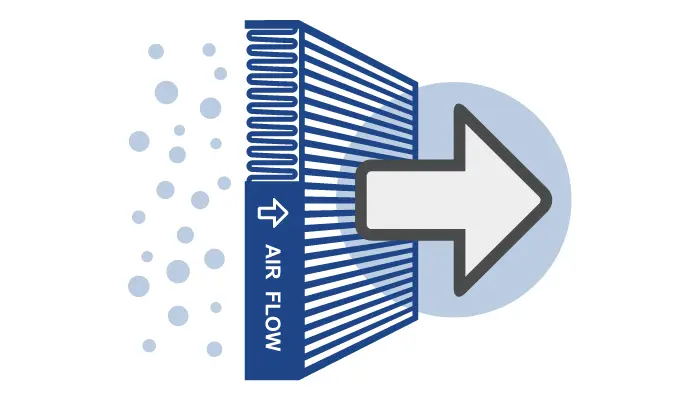
A filter that’s loose in its slot lets air bypass it entirely, which undoes the whole point. And the airflow arrow printed on the frame should point toward the furnace or air handler.
What a Filter Can’t Do
There are some limits to what a filter can and can’t do.
A furnace filter only cleans air while your system is running. During a bad smoke event, a portable HEPA air cleaner in your bedroom is a genuinely useful supplement.
Filters also capture particles, not gases. Wildfire smoke has a gas-phase component, which is why smoke odor can linger even with a good filter. A carbon-media filter helps with odor.
And filters do nothing for radon. Which matters here, because much of North Idaho and eastern Washington sits on geology that produces elevated radon levels. If you haven’t tested your home, that’s a separate and worthwhile project.
Not Sire What Your HVAC System Can Handle?
Our technicians can measure static pressure and recommend the right filtration for your home.
Call Prairie Heating & Air at 208-619-6480 for an indoor air quality assessment or contact us online with any questions.