
 Book Service!
Best Fall Thermostat Settings for North Idaho Homes
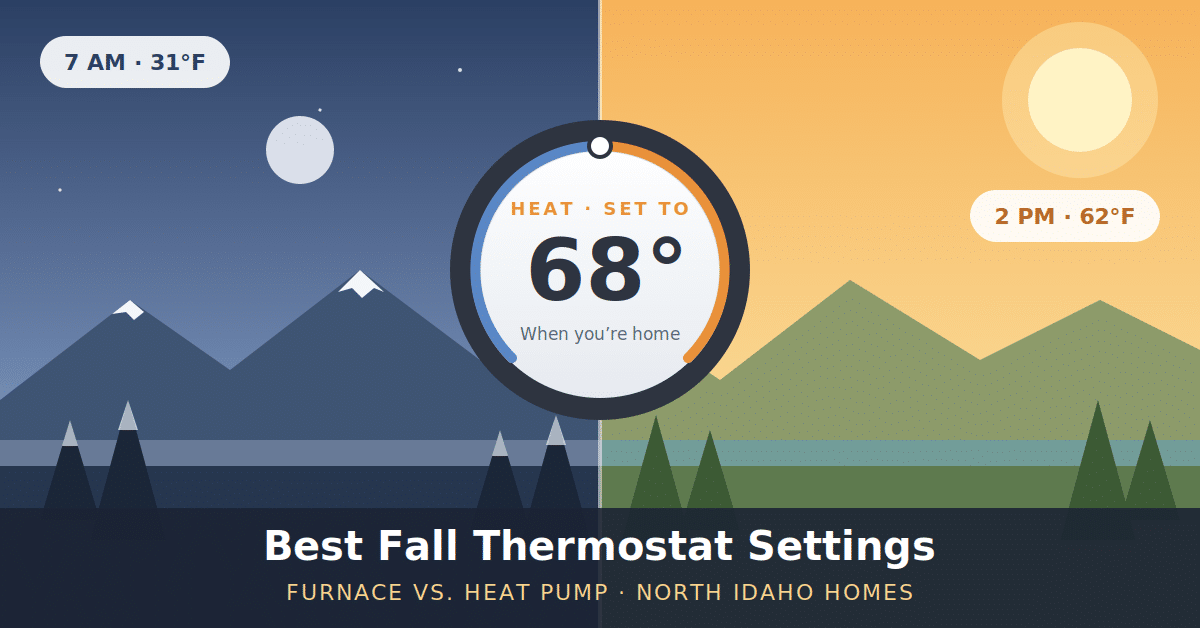
Fall in Coeur d'Alene and Post Falls means frost on the windshield at 7 a.m. and a sunny afternoon by 2. That swing is why so many homeowners end up chasing the thermostat all day.
Most advice online gives one number and one rule. That works for some homes and costs others money.
The right fall setting in the Inland Northwest depends on what heats your house:
- Gas furnace
- Heat pump
- Heat pump with a backup furnace
Here's what our HVAC technicians recommend for Inland Northwest homes, and why the answer is different for each system.
The starting point: 68°F when you're home
For most homes, 68°F while you're awake and home is a comfortable, efficient target. Anywhere from 64 to 70 is reasonable, depending on your household.
The bigger savings come from what you do when you're asleep or away. The U.S. Department of Energy estimates that turning the heat back 7 to 10 degrees for about 8 hours a day can cut yearly heating costs by up to 10%.
That rule works well for a gas furnace. For a heat pump, it can backfire.
Gas furnace vs. heat pump: why the rules differ
Gas furnace. A furnace makes heat by burning fuel, and it puts out the same heat whether it's 50°F or 10°F outside. A deep overnight setback is safe. The furnace runs a little longer in the morning to recover, and you still come out ahead.
Heat pump. A heat pump moves heat in from outdoors instead of making it. It works best running long and steady. Most heat pumps also have electric backup heat strips that turn on when the system can't keep up.
Here's the problem with a big setback. You drop the heat 8 degrees overnight. At 6 a.m. the thermostat asks for a large jump on a 30-degree morning. Many thermostats respond by firing the backup strips, which cost far more to run than the heat pump itself. That one recovery can wipe out the night's savings.
What Prairie Heating & Air recommends for heat pumps:
- Keep setbacks small. 2 to 4 degrees overnight, not 7 to 10.
- Use a heat pump thermostat with smart recovery. It starts warming early and slowly so the heat pump does the work, not the backup strips.
- Have the aux heat lockout set. A HVAC technician can program the backup heat to stay off above a set outdoor temperature. We typically set it around 35°F for North Idaho installs.
- Don't leave it on Emergency Heat. That setting runs only the backup strips. It's for a broken outdoor unit, not cold mornings.
Older heat pumps start leaning on backup heat once it drops below about 25°F. Cold-climate models like the Day & Night Crossover hold up much better in Idaho winters.
Dual fuel (heat pump + furnace). The thermostat switches to the furnace below a set outdoor temperature. Moderate setbacks of 4 to 6 degrees work well, as long as the switchover point is set correctly.
What our HVAC technicians see on fall service calls
The first cold mornings bring a familiar set of calls.
- A burning smell on first startup. Dust burns off the heat exchanger after months of sitting. It should fade within an hour. If it doesn't, read why your furnace smells like burning.
- Cold air from the vents. Often a thermostat, filter, or ignition issue. See why your furnace is blowing cold air.
- Heat pumps stuck on Emergency Heat. Someone switched it during a cold snap and forgot. The power bill is usually the first clue.
- Clogged filters left from wildfire season. A summer of smoke loads a filter fast. Here's how to pick the right filter.
Set a schedule, then leave it alone
The chilly-morning, warm-afternoon pattern tempts people to adjust the thermostat several times a day. A schedule handles it better.
Set it once for wake, away, home, and sleep, and let it run.
A Simple Fall Thermostat Schedule
Heat pumps get smaller setbacks to avoid costly backup heat during morning recovery.
On warm afternoons, the heat simply won't run. There's no need to switch the system off and back on.
Watch the humidity too. North Idaho air dries out fast once the heat comes on. Indoor humidity around 30–40% makes 68°F feel warmer, so you're less tempted to turn it up. If your home feels dry, ask us about indoor air quality options.
One more setting worth checking: keep the fan on Auto, not On.
Fall Thermostat FAQs
68°F when you're home and awake is a good target for most North Idaho homes.
Lower it at night and when you're away:
- 6–8 degrees for a furnace
- 2–4 degrees for a heat pump
A small setback is fine. A large one can trigger expensive backup heat when the system recovers in the morning. A heat pump thermostat with smart recovery avoids that.
No. If your schedule is set, the heat won't run when the house is already warm. Switching the system off and on just gives you a cold house by evening.
Before the first hard freeze. A tune-up catches weak ignitors, dirty burners, and heat pump issues before you need the heat most.
Need help with your thermostat settings?
If your bills jumped last fall, or your heat pump keeps running on backup heat, we can check your thermostat setup and aux heat settings on a visit.
Prairie Heating & Air offers no charge service calls across Coeur d'Alene, Post Falls, Hayden, Rathdrum, and the Spokane area.
Call 208-619-6480 to schedule your HVAC service or contact us online with any questions.
Looking to Upgrade Your HVAC Unit?
See our utility rebates through Avista, KEC, and Inland Power.