

 Book Service!
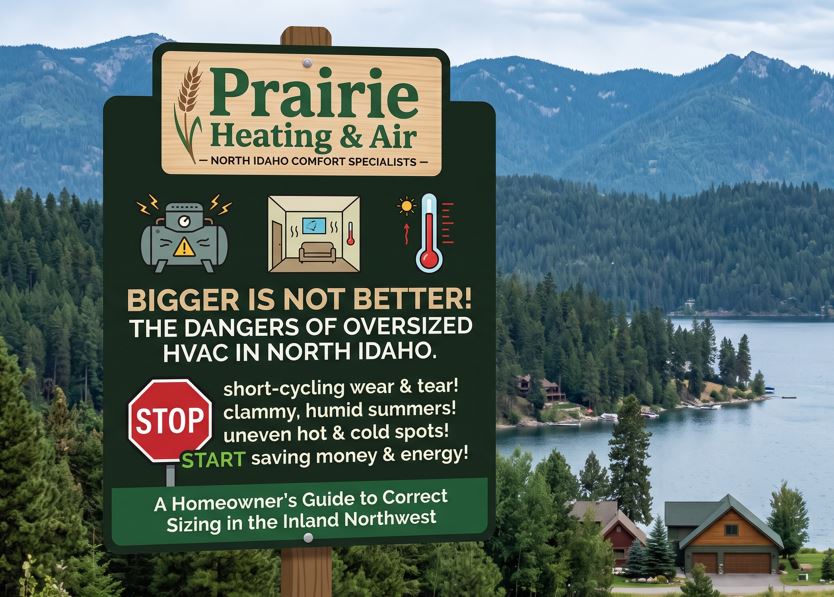
Why a Bigger HVAC System Isn’t Always Better in North Idaho
You called three HVAC companies to replace your furnace. Two of them walked the house for ten minutes, glanced at the old unit, and handed you a quote. One of those quotes is for an oversized HVAC system than what you have now and the salesperson said it like it was good news.
"We'll bump you up to a four-ton. You'll never have a problem."
When it comes time to replace an aging furnace or heat pump, many homeowners naturally assume that bigger is better. If a 3-ton air conditioner kept the house mostly cool, wouldn't a 4-ton unit make it even colder, faster?
Unfortunately, that logic backfires when it comes to home comfort.
Local HVAC contractors frequently quote and install systems that are far too large for the homes they serve. While salespeople often frame this as "playing it safe," installing an oversized unit actually leads to higher energy bills, drafty rooms, premature equipment breakdowns, and a far less comfortable home.
Prairie Heating & Air will explain how you can tell if the HVAC system you were just quoted is too big for your home and what it costs you in Coeur d'Alene, Rathdrum, Post Falls, and across the Spokane, WA area.
What Does Oversizing Actually Mean?
Oversized means the equipment's capacity is meaningfully larger than that calculated load.
And the research on this is not subtle: field studies have found the majority of residential systems installed at capacities well beyond what Manual J calls for. Commonly 25% to 50% over, with one large study finding more than half of the air conditioners checked were a full ton or more oversized.
Prairie Heating & Air has been experiencing a steady increase in calls lately asking about pricing for an oversized quote. We recognize this growing demand and remain committed to providing every customer with the prompt, professional service they deserve.
How Heating and Cooling Systems Are Measured
HVAC equipment capacity is measured in BTUs (British Thermal Units) for heating and Tons for cooling (where 1 ton equals 12,000 BTUs per hour).
Your house has a number too. On the coldest night of a normal winter, your home loses heat at a specific, calculable rate. On the hottest afternoon, it gains heat at a specific, calculable rate. Those two numbers are your heating load and cooling load, and finding them is the entire job of an industry procedure called ACCA Manual J.
Manual J isn't a rule of thumb. It's a room-by-room calculation that accounts for your square footage, ceiling heights, insulation levels, window sizes and orientations, glass type, air leakage, duct location, occupancy, and the specific outdoor design temperatures for where you live.
The North Idaho Numbers Most Quotes Ignore
Here's where generic HVAC advice falls apart, and where local homeowners get burned.
The design conditions used for Manual J calculations near Coeur d'Alene are roughly -1°F for winter and 86°F for summer, with a coincident wet bulb around 61°F and a wide daily temperature swing.
Head north to Sandpoint, Bonners Ferry, or up the Priest River valley and the winter number drops further. Get up on the Rathdrum Prairie on a still January night and it can be colder than the airport reading.
Three things follow from that, and every one of them argues against a bigger system:
1. We are a heating climate, not a cooling climate. Kootenai, Bonner, and Boundary counties are cold-dry zones. Your furnace or heat pump's heating capacity is the load that actually matters most days of the year. The air conditioner is, comparatively, a small job.
2. Our summers are dry. That 61°F coincident wet bulb is a very different animal than Houston or Atlanta. This cuts both ways, and we want to be straight with you: the standard national warning about oversized AC leaving your house "cool but clammy" is a much weaker argument here than it is in the Southeast. Humidity control isn't our primary problem. What is our problem is everything else on this list.
3. Our nights cool off hard. The Inland Northwest has a large daily temperature range. A right-sized system, running longer and steadier through the afternoon, tracks that swing smoothly. An oversized system slams the house cold in eight minutes and then sits idle while the temperature drifts back up.
The 5 Hidden Costs of an Oversized HVAC System
1. Short-Cycling and Rapid Mechanical Wear
An oversized furnace or air conditioner acts like a drag racer: it blasts on at full force, reaches the thermostat setting in 5 to 10 minutes, and abruptly shuts off. This rapid power-cycling is known as short-cycling.
The most taxing moment for any mechanical system is startup. Constant starting and stopping places severe mechanical stress on motors, electrical components, and heat exchangers, leading to frequent breakdowns and shortening the unit's lifespan by years.
2. Clammy, Uncomfortable Summers
Air conditioners don't just lower the air temperature; they pull moisture out of the air. To effectively dehumidify a home, an air conditioner needs to run continuously for extended periods, typically 20 to 30 minutes per cycle.
When an oversized unit cools your home down in 8 minutes, it shuts off before completing the dehumidification process. The result? Air that feels cold, damp, and sticky, leaving your indoor environment feeling drafty and uncomfortable even at 70 degrees.
3. Hot and Cold Spots Across Your Layout
Whether you live in a multi-story home in Hayden or a spread-out ranch home in Rathdrum, proper air circulation takes time. Rapid bursts of hot or cold air from an oversized system satisfy the thermostat, which is usually located near the center of the house, long before air reaches far bedrooms or second-story spaces.
4. Soaring Monthly Energy Bills
An HVAC unit draws its peak electrical surge when starting up. Because an oversized unit starts up dozens of times more per day than a properly sized one, it consumes significantly more electricity. Running a smaller, correctly sized system on a longer, steady cycle consumes far less energy than constantly spiking a oversized motor.
5. Excessive Air Noise and High Static Pressure
Forcing the air volume of a 4-ton system through ductwork originally sized for 3 tons creates high static pressure. Homeowners notice this immediately as rushing air noise, whistling vents, and rattling register grilles whenever the furnace or blower kicks on.
Why Do Local Contractors Keep Selling Oversized Systems?
This is usually not a con. It's a set of incentives that all push the same direction:
- Callback avoidance. If a system is undersized and a customer is uncomfortable on the one 98°F day in August, that's a miserable phone call and possibly a replacement on the contractor's dime. Oversizing is cheap insurance for the contractor.
- "Match what's there." The fastest quote in the world is replacing a 100,000 BTU furnace with a 100,000 BTU furnace. Nobody asks whether the original was correct.
- Square-footage rules of thumb. Old shortcuts like "one ton per 500 square feet" came from an era of leaky envelopes, single-pane windows, and incandescent lighting. ACCA's own guidance is that properly sized systems in modern homes usually land closer to 800–900+ square feet per ton. If someone sized your home in under a minute, they used a rule from a house that isn't yours.
- Oversizing hides installation problems. Leaky ducts, poor airflow, an improper refrigerant charge — extra capacity can mask all of it. The homeowner never learns the ductwork is the actual problem.
- Homeowners reward it. In a three-bid situation, the contractor who did the math and proposed the smaller correct system often loses to the one who offered "more." The market punishes the honest calculation.
How North Idaho Homeowners Can Protect Themselves
When getting quotes for a replacement heating or cooling system, take these steps to ensure you're getting the right fit for your home:
-
Demand a Manual J Load Calculation: Never accept a proposal based on square footage alone. A qualified contractor will measure window orientations, insulation depth, exterior wall construction, and door seals to run an accurate, data-backed heat gain/loss calculation.
-
Consider Inverter or Variable-Speed Technology: Modern variable-capacity heat pumps and multi-stage furnaces can adjust their output automatically. A variable-speed unit can run at 40% capacity on mild May days and ramp up to 100% capacity during a January deep freeze—giving you the best of both worlds.
-
Ask Direct Questions During Estimates:
-
"How did you determine the tonnage/BTUs for this quote?"
-
"Did you account for my home's insulation levels and window orientation?"
-
"Will my existing ductwork safely handle the airflow of this new unit?"
-
Your House Is Not the House Your Old Furnace was Sized For
This is the single most overlooked point in a replacement quote.
If your furnace was installed in 1998 and you've since added attic insulation, replaced windows, air-sealed the rim joist, re-sided with a housewrap, or finished the basement, your load has changed. Often dramatically. A lot of North Idaho homes that genuinely needed 100,000 BTUs thirty years ago now need 55,000 to 70,000.
Replacing like-for-like doesn't preserve your comfort. It locks in a calculation from a house that no longer exists.
When Bigger Genuinely is Right
Fairness matters, and undersizing is a real failure mode too. There are legitimate reasons a calculated system comes in larger than your old one:
- You're finishing a basement or adding a bonus room within the next couple of years
- You added square footage the old system was never sized for
- Your old system was genuinely undersized and struggled every January
- Major glass, high ceilings, or a great room the original design underestimated
- You're moving from a furnace-only setup to a heat pump and the heating load governs
The point of this article isn't always buy smaller. It's that the number should come from a calculation, not from a hunch, a habit, or a sales script.
Still Have Questions About Your HVAC System?
In a climate like North Idaho's, cold winters, short dry summers, big daily temperature swings, and weeks of smoke every fall, the system that keeps you most comfortable is the one that runs longer and steadier, not the one with the biggest number on the data plate.
Bigger equipment isn't more comfort. It's more capacity you'll never use, cycling harder, on ductwork that can't keep up, for more money.
Ask for the load calculation. Any HVAC contractor worth hiring will be glad you did.
Prairie Heating & Air performs full ACCA Manual J load calculations on every replacement quote in Coeur d'Alene, Post Falls, Hayden, Rathdrum, Sandpoint, and throughout North Idaho.
Call 208-619-6480 for a free quote or no diagnostic charge call out or contact us online with any questions.
Related Information