
 Book Service!
The “DIY” Diagnostic Guide for Homeowners in the Inland Northwest
We’ve all been there. You’re coming back from a dusty afternoon at Liberty Lake or a walk through Manito Park, and you step inside your home expecting a wall of cool air. Instead, it feels like the humidity of the South has finally found its way to Spokane, WA, Post Falls or Coeur d’Alene, ID.
Before you spend $150 just to have a technician pull into your driveway (Prairie Heating & Air offers No Charge Service Calls) in Spokane Valley, let’s talk about what your AC unit is actually trying to tell you.
In the HVAC world, symptoms are just a language. If you can translate the noise or the behavior, you can often fix it rather than a call to your local HVAC contractor.
1. The “Ghost Air” Mystery (AC Running, but Air is Lukewarm)
If your vents are blowing air but it feels like a weak desk fan, your system has lost its ability to perform heat exchange. In Spokane’s dry climate, the most common culprit isn’t a “freon” leak, it’s airflow restriction.
-
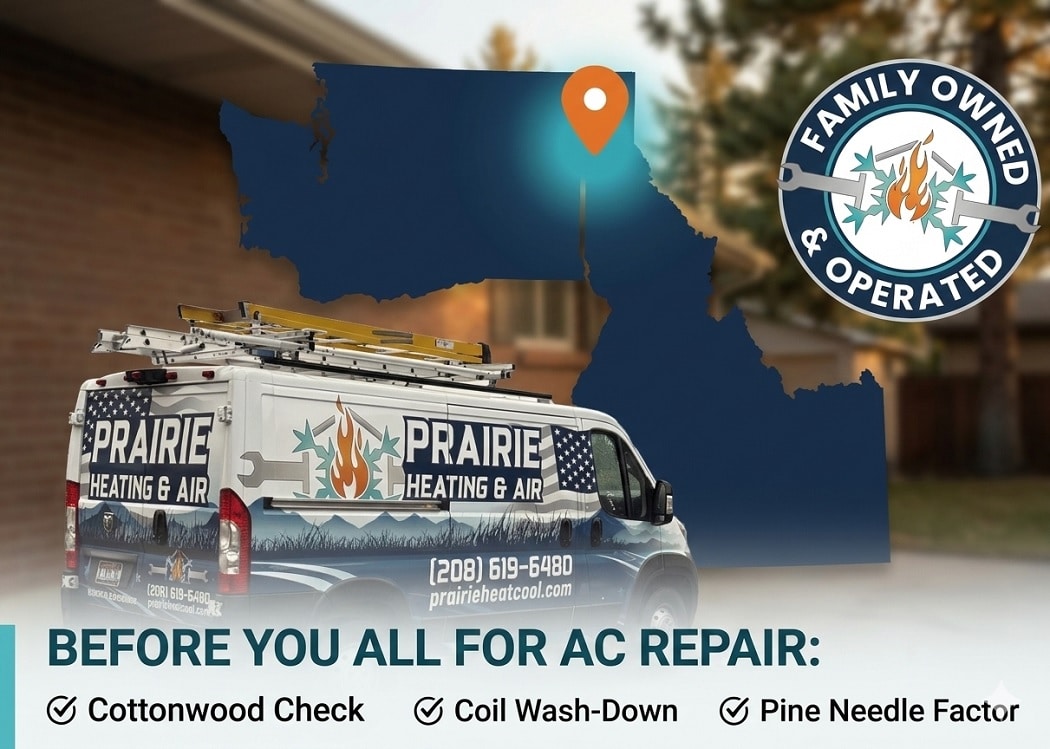
The DIY Check: Go outside to your condenser (the big box in the yard). Is it choked with cottonwood seeds? In June and July, Spokane’s cottonwoods act like a blanket, suffocating your AC.
-
The Inland NW Secret: Gently spray your outdoor coils with a garden hose (not a pressure washer!) at a 45-degree angle. This “wash-down” can drop your indoor vent temperature by 5°F to 8°F instantly.
If your coils are clear of cottonwood seeds but the air is still warm, you likely have a refrigerant issue that requires professional help to fix safely.
2. The Summer Icicle -Why is my unit frozen in 90°F heat?
It seems counterintuitive, but your cooling system can literally turn into a block of ice when it’s 100°F in South Hill. This is usually a relationship issue between pressure and evaporation.
-
The Concept: When airflow is restricted, the refrigerant gets too cold, and the moisture in our (admittedly low) humidity freezes to the coils.
-
The DIY Check: Check your HVAC filter. If you haven’t changed it since the last Bloomsday run, it’s likely blocked.
-
Crucial Step: Turn the system OFF but keep the FAN on. This uses the ambient Spokane air to melt the ice before a tech arrives. If a tech shows up to a frozen block, they can’t work on it anyway. They’ll just charge you for the time it takes to melt.
If your R-22 system is constantly freezing up, the cost of repairs might not outweigh the benefits of a modern upgrade. Check out our guide on energy-efficient HVAC maintenance to see how much you could save on your Avista bill.
3. The “Short Cycle” Stutter (Turning on and off every 5 minutes)
If your unit is “short cycling,” it’s often a safety mechanism. The system is sensing an internal conflict and “tripping” to prevent the compressor from exploding.
-
The Spokane Context: Many older homes in the Perry District or Garland have updated AC units but undersized ductwork. When the pressure builds up too high, the high-pressure switch cuts the power.
-
The DIY Check: Ensure at least 80% of your floor registers are wide open. Closing vents in unused rooms “to save money” actually kills your AC’s efficiency and causes short cycling.
4. Strange Noises (Grinding, Squealing, or Chattering)
-
Grinding: This is usually a bearing in the motor. There is no DIY fix for this. Turn it off before the motor seizes and causes a fire.
-
Chattering: In the Inland Northwest, this is often a contactor issue (a small electrical relay). If ants or debris get into the outdoor unit, they can get stuck in the contactor, causing a “buzzing” or “clicking” sound.
Grinding sounds usually mean a dry bearing. Regular annual AC tune-ups can catch these small parts before they turn into a total system meltdown.
The Inland Northwest Pine Needle Factor
In Spokane, we have Ponderosa Pine needles.
Unlike broad leaves that sit on top of your unit, pine needles are thin enough to fall into the fan shroud. Over time, they collect at the bottom of your AC cabinet, creating a damp “compost” layer that rusts out your base pan and eats away at the copper lines from the bottom up.
Your 5-Minute Maintenance: Once a season, use a shop-vac to suck out the pine needles from the interior base of your outdoor unit. Most local homeowners overlook this, and it’s the #1 reason units in the Shadle or North Hill areas fail prematurely.
When to Call the Pros at Prairie Heating & Air (Remember No Charge Service Calls)
If you’ve cleaned your coils, changed your filter, and checked your breakers, but the air is still warm, you likely have a failed capacitor or a refrigerant leak. Both require specialized tools and EPA certification to handle.
Call Prairie Heating & Air at 208-619-6480 to schedule your HVAC service with one of our local technicians to come out and get your AC system cooling again or contact us online with any questions.