
 Book Service!
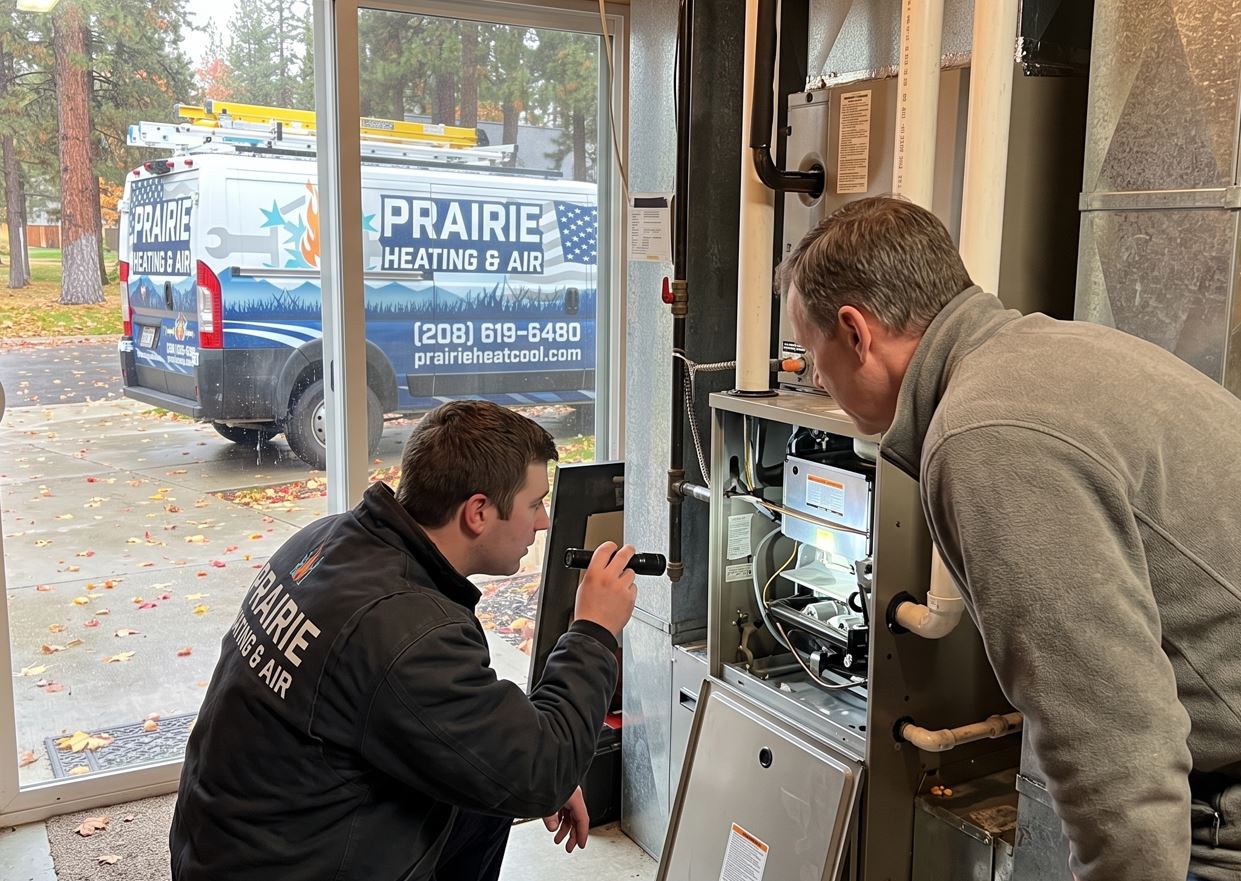
Why Your Furnace Smells Like Burning When First Turned On in North Idaho
A dusty burning smell the first time you turn on your furnace in the fall is normal. It's dust burning off parts that sat all summer. It should fade after a few hours of youe furnace running and be gone by the next day.
A smell like hot wires, melting plastic, or rotten eggs is not normal. Turn the furnace off and call Prairie Heating & Air for help.
Prairie Heating & Air's HVAC techs experience this smell every fall and winter in our North Idaho service area.
We'll explain why the smell happens where it does, how to tell if it's lasting too long, and a few causes that are common here in Coeur d'Alene, Post Falls, Spokane, and the rest of the Inland Northwest.
Why the Inland Northwest Area is Different
While most articles will tell you this is just "dust," living in North Idaho adds a few unique elements to the mix that make this smell particularly pungent:
-
Wildfire Smoke Residue: Late summer in the Panhandle often brings smoke. The ultrafine ash and particulate matter easily bypass standard air filters, settling directly onto your furnace burners and coils.
-
Pine Pollen: Our heavy spring pollen seasons leave a sticky, microscopic film on indoor surfaces, including the inside of your HVAC system.
-
Pet Hair & Dander: If you have indoor/outdoor dogs trekking through the woods and shedding all summer, pet dander is highly flammable and creates a uniquely unpleasant odor when it hits a hot furnace.
When these specific regional elements combine and burn off all at once, the smell can be quite strong.
Where the Smell Actually Comes From
Your gas furnace has two separate sides, and only one of them can make your house smell.
The fire side. This is where the burners and flame are. Dust that lands on the burners does burn off, but that smoke goes up the vent pipe and outside. You won't smell it in the living room.
The air side. This is the path your house air takes. The blower pushes air across the hot outside of the heat exchanger, then into the ducts. Dust sitting on that hot metal, on the blower, and in the first stretch of ductwork is what you smell.
Why does this matter?
Because it tells you what to clean. Wiping off the burners won't stop a first-run smell. A clean filter, a clean blower, and clean air-side surfaces will. It also explains why a dirty filter keeps a smell going. The filter sits on the air side, right before the hot parts.
Do you have electric heat strips?
Many heat pump homes and some older homes have electric heat strips in the air handler. Those coils glow hot with air blowing right across them. Dust on them gives a sharper, stronger smell than a gas furnace does. That's normal too, as long as it fades the same way.
How Long Should the Smell Last?
Ask five HVAC companies and you'll get five answers: 15 minutes, 30 minutes, an hour, a few cycles, or a full day. They're all a little bit right. The smell doesn't run on a clock. It runs on how long the furnace has actually been heating.
Think about a typical first heating day here. On a cool October afternoon, it might be 50 degrees outside. Your furnace runs for a few minutes, shuts off, and comes back an hour later. The dust burns off a little at a time, so the smell can come and go all day.
Now think about the first real cold night in November. The furnace runs long and steady. The dust burns off in one go, and the smell is gone in under an hour.
So here's a better rule of thumb:
- Normal: The smell gets weaker each time the furnace runs and is gone by the next day.
- Check your filter: The smell is still there the next day, but it's not getting stronger.
- Call a pro: The smell gets stronger, comes back every time the heat kicks on, or shows up weeks into the season.
What Your Furnace Smell Means
Use your nose first, then this table.
| What it smells like | What it probably is | What to do |
|---|---|---|
| Dusty, like a toaster or space heater that sat in the closet | Dust burning off the air side | Open a window and let it run. It should fade by tomorrow. |
| Smoky, like an old campfire | Wildfire smoke trapped in your filter, or neighbors' wood smoke pulled inside | Change the filter. See the North Idaho section below. |
| Musty or damp, like a basement | Old water in the AC drain pan or a humidifier pad that sat all summer | Change the filter and check the humidifier pad. Call if it stays. |
| Burning hair or something dead | A mouse nest or a mouse in the furnace or ducts | Turn the furnace off and call. Don't keep running it. |
| Hot plastic or melting | Something fell in a floor vent, or wire coating is melting | Check floor vents near the smell. Nothing there? Turn it off and call. |
| Hot wires, sharp electrical smell | An overheating motor, wiring, or control board | Turn it off at the thermostat and the furnace switch. Call now. |
| Rotten eggs or sulfur | A gas or propane leak | Leave the house now. Call from outside. See the gas section below. |
| Oily or a "new car" smell on a brand-new furnace | Factory oils burning off a new furnace | Normal for the first few days of use. |
North Idaho Causes Most Guides Miss
Most furnace smell articles are written for anywhere in the country. Our corner of the Inland Northwest has a few causes of its own.
Summer wildfire smoke in your filter
When smoke rolls in from fires in Idaho, Washington, Montana, or Canada, your AC pulls that air through the filter all summer. The filter catches the soot and holds the smell. When the furnace starts, that same filter is pushing a smoky odor through the house. If your first heat smells more like a campfire than dust, change the filter before anything else.
Wood smoke from the neighbors
Lots of homes around here heat with wood stoves. On a calm, cold evening, that smoke hangs low. Some homes have a small fresh-air duct that brings outside air into the furnace's return. If you smell campfire only on still, cold nights, the smoke may be coming from outside, not from your furnace. Your furnace isn't burning anything. It's just moving outside air in.
Mice moving in for the winter
Homes near fields, forest, and lake property see a lot of mice in the fall. They like the quiet, warm space inside a furnace cabinet or a duct. A nest near the blower, or a mouse that didn't make it, gives off a burning hair smell or a rotten smell. This is not a dust smell, and it won't burn off. Turn the furnace off and have it cleaned out.
Heat pump homes get the smell twice
If you have a heat pump with backup heat, the first warm air in October usually doesn't smell much. The heat pump moves heat without burning anything. The smell often shows up weeks later, on the first really cold night, when the backup heat turns on for the first time. People think something broke. Usually it's just dust on the backup heat burning off for the first time that season.
Dry winter air and humidifiers
Our winters are dry, so many homes have a whole-home humidifier on the furnace. The pad inside sits damp or dirty all summer. When the furnace starts, it can make the house smell musty. Replace the pad each fall, before the first heating day.
Just had a new furnace put in?
New furnaces have oils and coatings from the factory. They burn off during the first several hours of heating. It can smell oily or a little like a new car. That's normal and should go away within the first few days.
If You Smell Gas or Propane
Natural gas and propane have no smell on their own. Suppliers add a chemical that smells like rotten eggs so you can tell when there's a leak.
If you smell it, treat it as an emergency.
- Get everyone out of the house, including pets.
- Don't flip light switches, start the car in an attached garage, or light anything.
- Wait until you're outside to make a phone call.
- Call 911 and your gas company. For most homes in Coeur d'Alene, Post Falls, and Spokane, that's Avista. If you're on propane, call your propane supplier.
- Don't go back in until they say it's safe.
A Note for Propane Homes
Many homes in Athol, Harrison, and other rural areas heat with propane. Propane is heavier than air, so a leak settles low, near the floor or in a basement. You may smell it more strongly down low than at nose height.
The smell added to propane can also fade. This happens most with new tanks, new lines, or after a tank runs empty. That's why propane safety groups recommend a propane gas detector in propane homes, in addition to a carbon monoxide alarm. Don't count on your nose alone.
When to Call Prairie Heating & Air
Call us if any of these are true:
- The smell is still going strong the day after a filter change.
- It smells like hot wires, plastic, burning hair, or something dead.
- The smell comes with the furnace shutting off on its own, a tripped breaker, or a new noise.
- You see smoke coming from a vent or the furnace.
- A CO alarm goes off. Get outside first, call 911, then call us.
Prairie Heating & Air is a local, family-run team that services furnaces, heat pumps, and propane systems in Coeur d'Alene, Post Falls, Hayden, Rathdrum, Spokane, and nearby towns.
We answer the phone 24/7, and service calls are no charge.
Call 208-619-6480 to schedule your HVAC service or contact us online with any questions.
How to Prevent the Smell Next Fall
Want to skip the smelly house next year? Try these advanced tips that go beyond the basic "change your filter" advice:
-
The Pre-Season Fan Flush: Before you turn your heat on for the first time, change your air filter. Then, turn your thermostat from "Auto" to "ON" (leaving the heat OFF) for 20 minutes. This runs the blower motor and flushes loose dust and pet hair out of the system before the burners get hot enough to incinerate them.
-
Clear Your Outdoor PVC Intakes: If you have a high-efficiency furnace, you have white PVC exhaust and intake pipes sticking out of the side of your house. In North Idaho, these easily get clogged with pine needles, spiderwebs, or early snow. Clear them out in September to ensure your furnace has proper airflow.
-
Upgrade to a Winter MERV Filter: During wildfire season, you might use a highly restrictive filter to block smoke. In the winter, your furnace needs maximum airflow to prevent overheating. Ask your local HVAC tech which filter rating is the perfect balance for your specific system.
The Importance of Preventative Maintenance in North Idaho
Winter in the Inland Northwest is long, dark, and unforgiving. Your furnace is going to work incredibly hard from November through April.
While a burning smell might just be dust, it can also be the first warning sign of a failing motor or a stressed system.
Scheduling an annual fall tune-up with a licensed, local HVAC expert ensures that your burners are cleaned, your electrical connections are tight, and your heat exchanger is tested for cracks. A clean, inspected furnace won't smell when you turn it on and more importantly, it won't leave you freezing on a sub-zero January night.
Book a fall furnace tune-up with Prairie Heating & Air by calling 208-619-6480 or contact us online with any questions.
We will clean the air-side parts, check the heat exchanger, and test for CO before winter hits.